AEO
What Is Answer Engine Optimization (AEO)? A Complete Guide for Businesses
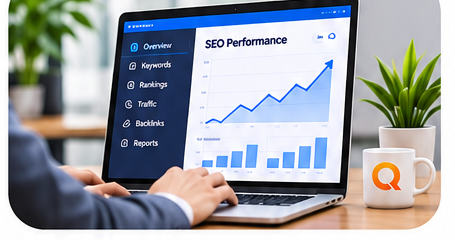
Answer Engine Optimization helps your website become the source that search engines and AI assistants quote when someone asks a direct question. This guide explains how it works, how it differs from SEO, and what to fix first.
Ask a search engine a full question today and you often get an answer, not a list of links. Ask an AI assistant the same question and you get a short paragraph with a couple of citations. Both behaviours depend on the same underlying skill: writing and structuring a page so a machine can lift one clean, self-contained answer out of it. That skill is what people now call Answer Engine Optimization.
Why answer engines changed the shape of search
Traditional search rewarded pages that matched keywords and earned links. The results page was a menu: ten titles, and the user chose. Answer engines changed the contract. Google's AI Overviews, Bing's Copilot answers, ChatGPT's web-grounded responses and Perplexity all attempt to summarise first and cite second. The user may never scroll to a blue link at all.
For a business website this is a meaningful shift. Being ranked third is still useful, but being the source quoted in the summary is often more visible than being the first link. AEO is about earning that position by making your content easy to verify, easy to quote and hard to misread.
How answer engines actually choose a source
No one outside the search companies knows the full ranking logic, and anyone who claims otherwise is guessing. What is observable, and what Google documents, is the direction of travel: systems need passages they can understand in isolation, confirm against other sources, and attribute to a credible page. In practice that means four conditions tend to matter.
- Extractability. A sentence or short paragraph that answers the question without needing the preceding three paragraphs for context.
- Clear entities. The page names the thing it is about explicitly — the product, the concept, the place, the service — rather than relying on pronouns and implication.
- Corroboration. Claims that are consistent with other reputable pages on the same subject, which is why unsupported superlatives get filtered out.
- Technical clarity. Crawlable HTML, sensible headings, and structured data that does not contradict the visible copy.
Notice that none of these are tricks. They are the same qualities that make an article useful to a busy human reader who skims the first two sentences of each section.
AEO and SEO are not competing strategies
AEO is usually described as a replacement for SEO. It is better understood as a subset with a different measurable outcome. Technical health, crawlability, internal linking and topical depth all still apply. What changes is the output you optimise for: not only a ranking position, but a quotable passage.
| Aspect | Traditional SEO | Answer Engine Optimization |
|---|---|---|
| Primary goal | Rank a URL for a query | Be the passage an engine quotes or cites |
| Success signal | Position, impressions, clicks | Citations, brand mentions, qualified sessions |
| Content shape | Long pages covering a topic | Topic coverage plus extractable answer blocks |
| Headings | Keyword-aligned | Question-shaped and specific |
| Structured data | Helpful, sometimes optional | Strongly recommended to remove ambiguity |
| Risk to avoid | Thin content and keyword stuffing | Vague claims that cannot be verified or quoted |
If your technical SEO is weak, AEO work will underperform, because an engine that cannot crawl or render the page cannot quote it. That is why we usually fix indexing and page speed before rewriting copy — the same order we follow in our SEO services engagements.
How to structure a page for answer engines
The practical work is editing, not engineering. Start with a page that already ranks or that you want to rank, and restructure it in this order.
- Write the answer in the first two sentences. Under the heading, answer the question immediately, then explain. Readers who want depth keep reading; engines get a clean extractable unit.
- Make every key sentence stand alone. Replace "it", "this" and "they" with the actual noun where the meaning would otherwise be ambiguous.
- Use the language your customers use. Match the phrasing of real questions rather than internal jargon or product names nobody searches for.
- Break long sections into question-shaped H2 and H3 headings. Each heading should correspond to a question a customer would genuinely ask.
- Add a comparison table where the question is comparative. Tables answer "X vs Y" questions more cleanly than prose.
- Add an FAQ section only where it reflects real enquiries. Inflated FAQs with invented questions dilute rather than help.
Write for the skim, then for the read
A useful test: cover the body text and read only the headings. If the headings alone answer the question in a logical sequence, the structure is doing its job. If they read like a list of keywords, it is not. This is also the structure an AI summary naturally follows when it reconstructs your argument.
Do not answer questions you cannot support
Answer engines increasingly discount claims they cannot corroborate. Specific numbers — market size, average cost, percentage uplift — are the most quotable material and the most damaging when wrong. If you cannot cite a source you would defend in a client meeting, describe the range and the variables instead of inventing a figure.
The technical layer: structure and structured data
Content quality does most of the work, but a small technical layer removes ambiguity about what the page is. Three things matter most.
- Valid, server-rendered HTML. If the answer only exists after client-side JavaScript runs, some crawlers and most AI fetchers will never see it.
- One clear H1 that states the subject. Followed by a logical H2/H3 hierarchy that reflects the actual argument.
- Structured data that matches the visible content. Schema.org markup for articles, FAQs and organisations helps machines classify the page. Markup that describes content the reader cannot see is a liability, not an advantage.
Structured data is not a shortcut to rich results. Google decides independently whether to display them, and eligibility is not a guarantee. Treat schema as clarification, not promotion.
What AEO cannot promise
It is worth being direct about the limits, because the market around AI search is full of overstatement.
- No service can guarantee that ChatGPT, Gemini, Perplexity or Google will quote your page.
- There is no verified set of "AI ranking factors" you can optimise against mechanically.
- Adding FAQ schema does not reliably produce FAQ rich results.
- Volume of AI-related keywords is not a substitute for subject expertise.
- Traffic from AI answers is often harder to attribute, because referrals are frequently stripped.
What AEO does reliably improve is the clarity and quotability of your content — which also improves how useful it is to human readers. That is the honest case for doing it.
A realistic way to start this month
- Pick five pages that already earn impressions but few clicks. These are the pages where an extracted answer would change the outcome most.
- Find the question behind each one. Use your own sales enquiries and support emails — they are better than any keyword tool for phrasing.
- Rewrite the first two sentences of each section so the answer comes first and the sentence stands alone.
- Add a comparison table or a short FAQ where the question is genuinely comparative or repetitive across customers.
- Validate structured data and confirm the markup matches what is on the page.
- Measure citations and mentions, not just clicks. Manual checks in the assistants your customers use are more honest than most dashboards here.
Frequently asked questions
Frequently asked questions
Is AEO different from SEO?
AEO is a subset of SEO focused on making content extractable and quotable by answer engines. The technical foundations overlap almost entirely; the difference is in how you structure headings and paragraphs so a single passage can answer a question on its own.
Does AEO only apply to AI chatbots?
No. Featured snippets, People Also Ask panels and voice assistant responses are all answer-engine surfaces that predate generative AI, and they respond to the same content structure.
How long does answer engine optimisation take to show an effect?
It depends on how quickly your pages are recrawled and how competitive the question is. Structural edits to an already-indexed page can be reflected within weeks, while building topical credibility for a competitive subject is a longer effort. Be cautious of anyone quoting a fixed timeline.
Can AEO replace traditional SEO?
It should not. Answer engines still draw on indexed, crawlable pages, which means technical SEO and internal linking remain prerequisites. AEO changes what you optimise for within a page, not whether crawling and indexing matter.
Where to go next
Answer Engine Optimization rewards businesses willing to write plainly about what they actually do. The work is unglamorous — clearer headings, shorter sentences, fewer unsupported claims — but it compounds, because the same edits improve how both people and machines understand the page.
If you would like help restructuring your key pages, our team handles answer engine optimization alongside technical and on-page SEO. You can also review our service pricing or read more practical guidance on the Qissba Technologies blog.
Further reading: Google Search Central documentation and the Schema.org vocabulary reference.
Related reading
Related articles
- SEO vs AEO: What's the Difference and Does Your Business Need Both?
- Is Artificial Intelligence Now Super Intelligence? What It Means for Indian Businesses
- What Is Custom Software Development and When Does Your Business Need It?
- Why Every Business Needs a Professional Brand Identity
Read more articles on the Qissba Technologies blog · Talk to Qissba Technologies